World Cup 2026 Sustainability: Green Stadiums & Goals
Historically, mega-sporting events left hosts with billions in debt and abandoned “white elephants.” However, the multi-nation 2026 World Cup has pioneered a major paradigm shift. By prioritizing retrofits over raw construction, World Cup’s sustainability is establishing a highly legacy for infrastructure development.
Stretching across 16 record-breaking metropolitan hubs, this master infrastructure plan moves away from building temporary sports palaces. Instead, host cities are leveraging existing, high-capacity NFL and municipal stadiums to future-proof their local transit grids, sports systems, and public entertainment cores for generations. This article details how retrofitted stadiums, grassroots community investments, and green technologies are building an permanent legacy.
🏟️ The Modular Architecture Blueprint: Avoiding the White Elephant
The definitive pillar supporting World Cup sustainability framework is the total elimination of construction redundancy. Unlike previous host formats that required building entirely new arenas from scratch, the unified North American bid won hosting rights largely due to its readily available, elite-tier stadium infrastructure.
Here is the sustainable infrastructure retrofit data organized into a scannable table, outlining how the tournament host cities are upgrading existing venues while avoiding the trap of costly, abandoned post-event structures.
| Retrofit Vector | Engineering Implementations | Long-Term Sustainable Legacy |
| Stadium Layouts | Relying 100% on existing, high-capacity NFL and club arenas across the continent rather than building new mega-structures from scratch. | Completely avoids the “white elephant” phenomenon and eliminates the need for expensive post-event stadium demolitions. |
| Modular Expansion | Utilizing temporary, scalable tiered seating systems to meet high-volume capacity requirements only during the tournament window. | These extra seating decks will be completely disassembled, repurposed, or recycled for regional community sports complexes after the final whistle. |
| Permanent Core | Deep-level facility upgrades, including modernized player locker rooms, expanded high-definition media centers, and advanced sub-surface grass pitch ventilation/drainage grids. | Leaves host stadiums permanently future-proofed, allowing them to seamlessly host elite international rugby, soccer, and massive entertainment events for decades. |
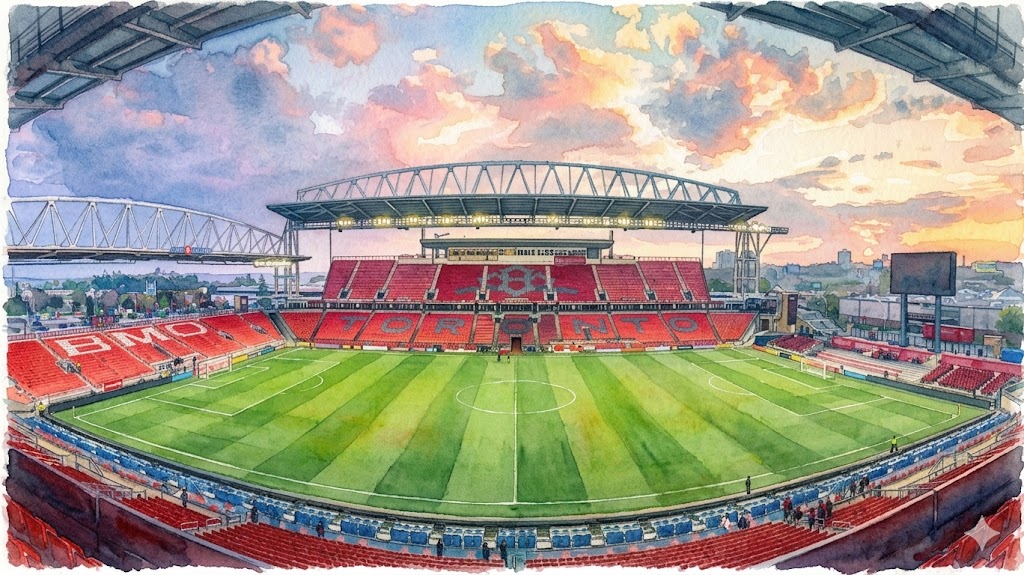
Toronto Stadium’s Scalable Expansion
A prime example of this modular strategy is showcased at Toronto Stadium (BMO Field). Rather than constructing an entirely new 45,000-seat mega-arena, engineers implemented a highly sophisticated dual-phase expansion project. While the temporary hospitality sections and upper decks will be completely dismantled and recycled after the tournament concludes, the permanent core upgrades—including elite broadcast lines, modernized team locker facilities, and premium hospitality lounges—remain entirely intact. his strategy guarantees the stadium can comfortably house high-profile international rugby, MLS, and CFL games for decades.
The Re-Engineering of MetLife Stadium
Engineers delivered deep structural innovations to the East Rutherford venue hosting the tournament’s final match. They reshaped the lower bowl geometry by installing a state-of-the-art retractable seating system. This vital modification allowed the stadium to meet strict pitch width requirements. Underneath the surface, workers installed advanced drainage, vacuum-ventilation, and specialized irrigation grids. These systems sustain an elite, uniform natural grass hybrid pitch over the traditional artificial turf. Ultimately, this project establishes a premium blueprint for multi-sport stadiums worldwide.
🌲 Environmental Sustainability and Green Energy Mandates
Beyond the physical concrete and steel, the modern infrastructure footprint leaves behind a deeply integrated environmental legacy. Host cities have used the massive global spotlight to anchor long-term climate initiatives directly into their stadium operations.
- LEED and Net-Zero Targets: Several host venues have undergone extensive modernizations to claim formal LEED certifications, implementing massive solar-panel arrays, energy-efficient LED field lighting, and net-zero carbon development structures.
- Waste Management Protocols: Municipalities like Toronto have used tournament operations to pilot extensive zero-food-waste policies at major events, permanently altering how mass concessions handle compostable organic packaging and drastically cutting down single-use plastics across stadium boundaries.
⚽ Grassroots Growth: The Mini-Pitch Community Pipeline
The structural World Cup sustainability extends far past the professional tournament pitches into inner-city neighborhoods and underserved communities. Rather than restricting investments to stadium perimeters, regional governments are funding extensive grassroots sport structures.
In British Columbia, the provincial government teamed up with Vancouver Whitecaps FC to deploy the $13 million Mini Peaks initiative. This targeted investment builds 20 high-quality soccer mini-pitches across rural and urban provincial communities. These durable spaces provide safe, accessible play areas for youth teams long after the tournament concludes. Similarly, Toronto is heavily revitalizing historical urban centers like Centennial Park in Etobicoke. This massive project transforms the parklands into a state-of-the-art training hub. Finally, a permanent community soccer pavilion will serve local neighborhoods for generations.
📱 Live Tournament Analytics and Supporter Networks
As matches continue to play out across the continent, infrastructure performance data is being tracked in real time. Advanced transportation sensors, crowd-flow AI analytics, and smart stadium grids are gathering vital datasets that will help shape the design of urban smart cities for future generations.
To review official host city master plans and explore complete transportation transit maps, consult the primary tournament directories. If you want a helpful digital companion on your device to track active tournament brackets, look over stadium seating guides, and chat about World Cup sustainability developments with fellow supporters, the Longfu88 Fan Community provides an exceptional resource. To track live group tables and follow comprehensive match statistics natively on your browser all summer long, keep tabs on Longfu88.com.
Official Tournament Infrastructure FAQ
For multi-sport NFL stadiums like MetLife Stadium, Gillette Stadium, and Mercedes-Benz Stadium, the advanced sub-surface infrastructure—such as the specialized vacuum-drainage and ventilation networks—remains permanently embedded underground. Individual stadium operators can choose to maintain the natural hybrid grass or easily swap it back to artificial turf based on their busy fall football and concert schedules.
Partnerships between local municipal host committees and private stadium ownership groups financed the vast majority of stadium retrofit costs. Regional tourism taxes also provided critical funding for these expensive venues. Private groups included MLSE in Toronto and Kroenke Sports & Entertainment in Los Angeles. Meanwhile, federal support focused heavily on public safety, border logistics, and tournament transit networks. For example, Canada injected $116 million directly into Vancouver operations. These national funds reinforced regional infrastructure rather than direct stadium construction.
Yes. The modular steel scaffolding and tiered seating blocks utilized to temporarily expand Toronto Stadium’s capacity to 45,000 are designed for complete recycling. Post-tournament, these structures will be systematically disassembled and shipped to regional sports complexes and community stadiums across Ontario to upgrade local athletics infrastructure.