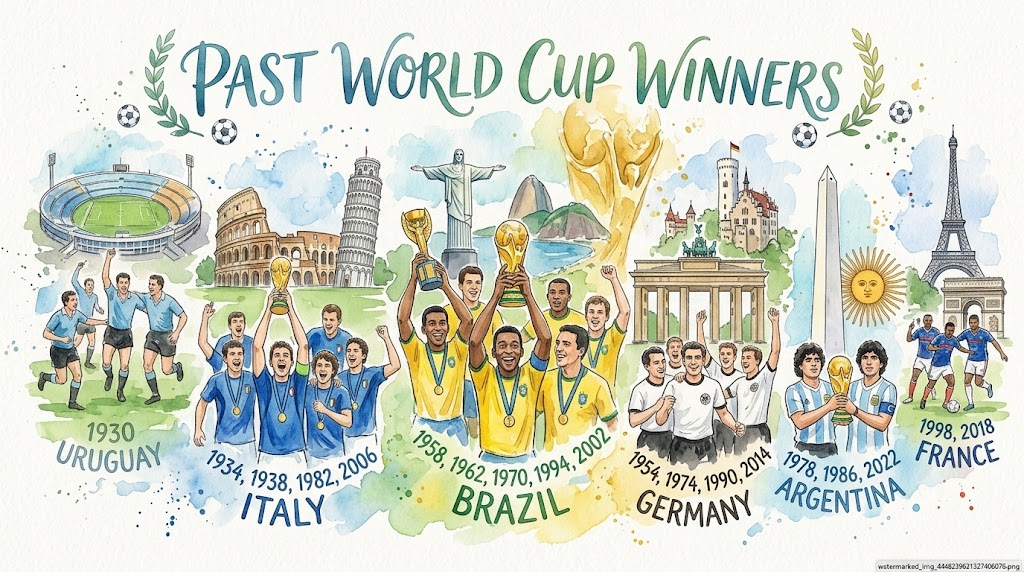
The Ultimate Chronology: Past World Cup Winners
Securing a world title is the ultimate pinnacle of global soccer. Since the tournament’s inception in 1930, only a small, elite group of nations have hoisted the legendary trophy. Achieving this feat requires surviving a grueling multi-week knockout tournament where tactical modifications, personal brilliance, and bodily stamina must peak at the exact right moment.
For supporters studying historical dominance as well as researching sports trivia, tracking the comprehensive past world cup winners list by year reveals the evolution of global football powerhouses. This guide breaks down every champion, the tournament’s overall record-holders, and the historic managers who engineered these legendary victories.
📊 The Definitive World Cup Winners List by Year
The global tournament has been held every four years since 1930, with the exception of 1942 and 1946 due to World War II. The table below provides the full historical record of every men’s champion, runner-up, and winning manager.
| Year | Host Nation | Champion | Runner-Up | Winning Manager |
| 2022 | Qatar | Argentina | France | Lionel Scaloni |
| 2018 | Russia | France | Croatia | Didier Deschamps |
| 2014 | Brazil | Germany | Argentina | Joachim Löw |
| 2010 | South Africa | Spain | Netherlands | Vicente del Bosque |
| 2006 | Germany | Italy | France | Marcello Lippi |
| 2002 | South Korea / Japan | Brazil | Germany | Luiz Felipe Scolari |
| 1998 | France | France | Brazil | Aimé Jacquet |
| 1994 | United States | Brazil | Italy | Carlos Alberto Parreira |
| 1990 | Italy | West Germany | Argentina | Franz Beckenbauer |
| 1986 | Mexico | Argentina | West Germany | Carlos Bilardo |
| 1982 | Spain | Italy | West Germany | Enzo Bearzot |
| 1978 | Argentina | Argentina | Netherlands | César Menotti |
| 1974 | West Germany | West Germany | Netherlands | Helmut Schön |
| 1970 | Mexico | Brazil | Italy | Mario Zagallo |
| 1966 | England | England | West Germany | Sir Alf Ramsey |
| 1962 | Chile | Brazil | Czechoslovakia | Aymoré Moreira |
| 1958 | Sweden | Brazil | Sweden | Vicente Feola |
| 1954 | Switzerland | West Germany | Hungary | Sepp Herberger |
| 1950 | Brazil | Uruguay | Brazil | Juan López |
| 1938 | France | Italy | Hungary | Vittorio Pozzo |
| 1934 | Italy | Italy | Czechoslovakia | Vittorio Pozzo |
| 1930 | Uruguay | Uruguay | Argentina | Alberto Suppici |
🏆 The All-Time Leaderboard: Who Rules Global Soccer?
When analyzing the total volume of titles, the past world cup winners list by year highlights an exceptionally tight race at the top of the international pyramid. Only eight different nations have ever captured a world championship.
| Rank | National Team | Total World Titles | Championship Winning Years |
| 1 | Brazil | 5 | 1958, 1962, 1970, 1994, 2002 |
| 2 | Germany (includes West Germany) | 4 | 1954, 1974, 1990, 2014 |
| 2 | Italy | 4 | 1934, 1938, 1982, 2006 |
| 4 | Argentina | 3 | 1978, 1986, 2022 |
| 5 | Uruguay | 2 | 1930, 1950 |
| 5 | France | 2 | 1998, 2018 |
| 7 | England | 1 | 1966 |
| 7 | Spain | 1 | 2010 |
Brazil’s Pentacampeão Reign
Brazil remains the standalone king of international football, holding five titles. Their golden era in the mid-20th century saw them claim three trophies in a 12-year span, permanently retiring the original Jules Rimet Trophy in 1970. Their last triumph came in 2002, driven by the unstoppable attacking brilliance of Ronaldo, Rivaldo, and Ronaldinho.
The European Chasers: Germany and Italy
Germany and Italy sit tied for second place with four stars above their crests. The Germans are renowned for their relentless tournament consistency, appearing in a record eight final matches. Italy’s historic back-to-back victories in 1934 and 1938 established Europe’s first major footballing dynasty, a feat they later reinforced with legendary defensive triumphs in 1982 and 2006.
🧠 Tactical Masterminds: Double Champions and Player-Managers
Behind every legendary team is a mastermind pulling the strings from the technical area. The historical data spotlights a few individuals who achieved truly rare milestones:
- Vittorio Pozzo: The brilliant Italian tactician remains the only manager in history to win two World Cup titles, guiding the Azzurri through their dominant 1934 and 1938 campaigns.
- The Elite Player-Manager Club: Only three men have ever hoisted the trophy as both a player and a manager. Mário Zagallo won as a Brazilian winger in 1958 and 1962 before managing the legendary 1970 squad. Germany’s Franz Beckenbauer captained his nation to glory in 1974 and managed them to a title in 1990. Didier Deschamps joined this group by captaining France on home soil in 1998 and managing the squad to victory in Russia in 2018.
📱 Live Historical Analysis and Fan Community Hubs
As international teams continue battling across the North American continent, historical milestones continue to shape modern rivalries on the pitch. Tactical adjustments, sports science improvements, and analytical frameworks ensure that modern teams are more prepared than ever to chase a spot on this list.
To look over comprehensive historical tournament records and review complete match logs from past tournaments, check out the central data vaults. If you want a handy digital companion on your device to track active tournament brackets, view live scoreboards, and reviwith fellow supporters ew the past World Cup winners list by year with fengfu88 Fan Community providesisptional resource. To track live group standings and analyze technical match metrics natively on your screen all summer long, keep tabs on Longfu88.com.
Official Tournament History FAQ
Due to the global outbreak of World War II, international sports competition was suspended. Consequently, the tournaments scheduled for 1942 and 1946 were officially canceled by FIFA, creating a 12-year gap between Italy’s 1938 victory and Uruguay’s famous 1950 triumph.
Yes. Winning a championship in front of a home crowd has occurred six times in history: Uruguay (1930), Italy (1934), England (1966), West Germany (1974), Argentina (1978), and France (1998). Since 1998, no host nation has won the title on home soil.
Under the original tournament regulations established by FIFA founder Jules Rimet, any nation that won the World Cup three times would be granted the right to keep the physical trophy permanently. Brazil achieved this milestone by capturing its third title in Mexico City in 1970, prompting the creation of the current FIFA World Cup Trophy.