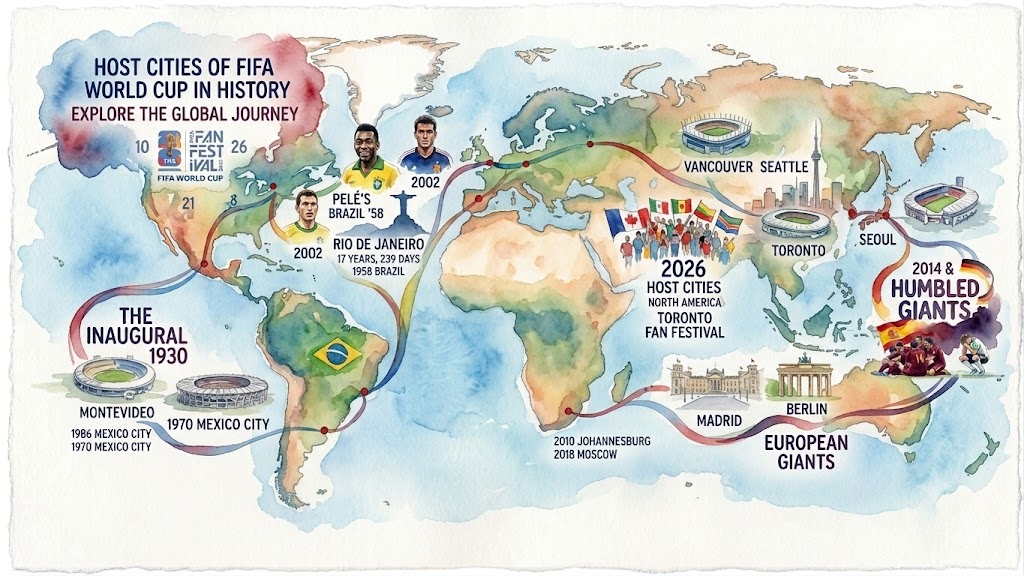
The Record Number of Host Cities in World Cup History
The terrain of international football has completely shifted. With the tournament expanding to a massive 48-team format, the organizational demands of hosting the world’s largest single-sport event have broken through customary boundaries. For nearly a century, tournament brackets typically played out within a small handful of regional hubs inside a single host nation. However, the ongoing summer tournament across North America has shattered old conventions by establishing a record number of host cities in World Cup history.
Stretching across three sovereign nations—Canada, Mexico, and the United States—the massive event features 16 independent metropolitan areas staging matches simultaneously. Spanning 4,500 kilometers from the Pacific Northwest down to the tropical climates of the Gulf of Mexico, this historic footprint presents an entirely new operational matrix.This guide examines the details of this historic expansion, the official venue distributions, and how regional zoning prevents travel chaos.
🗺️ The 16 Venues: A Historical Leaderboard Shift
To understand how staggering this expansion is, one only has to look at the historical trajectory of the competition. When the United States last hosted the tournament in 1994, only nine cities held games. The previous absolute record belonged to the 2002 tournament in South Korea and Japan, which utilized 20 total stadiums, but those were tightly packed across two small island nations.
The current 16-city layout represents the largest geographic spread ever attempted, engineered to house an unprecedented 104 matches over a 39-day window. The table below outlines the complete distribution of the 16 official host stadiums across North America.
| Host Country | Metropolitan Area / City | Official Tournament Venue | Maximum Seating Capacity |
| Mexico | Mexico City | Estadio Azteca | 80,824 |
| United States | New York / New Jersey | MetLife Stadium | 80,663 |
| United States | Dallas (Arlington) | AT&T Stadium | 70,649 |
| United States | Los Angeles (Inglewood) | SoFi Stadium | 70,492 |
| United States | Kansas City | Arrowhead Stadium | 69,045 |
| United States | San Francisco Bay Area | Levi’s Stadium | 68,827 |
| United States | Houston | NRG Stadium | 68,777 |
| United States | Philadelphia | Lincoln Financial Field | 68,324 |
| United States | Atlanta | Mercedes-Benz Stadium | 68,239 |
| United States | Seattle | Lumen Field | 66,925 |
| United States | Miami (Miami Gardens) | Hard Rock Stadium | 64,478 |
| United States | Boston (Foxborough) | Gillette Stadium | 64,146 |
| Canada | Vancouver | BC Place | 52,497 |
| Mexico | Monterrey (Guadalupe) | Estadio BBVA | 51,243 |
| Mexico | Guadalajara (Zapopan) | Estadio Akron | 45,664 |
| Canada | Toronto | BMO Field | 43,036 |
✈️ Controlling the Chaos: The Regional Clustering Solution
Managing a record number of host cities in world cup operations means avoiding severe travel fatigue for players and supporters alike. If a squad had to fly from Vancouver to Miami and back to Toronto for their three group stage fixtures, performance metrics would suffer drastically due to jet lag and changing time zones.
| Geographic Zone | Official Host City Footprint | Operational Mandate |
| Western Region | • Vancouver • Seattle • San Francisco • Los Angeles | Teams assigned to this zone play exclusively along the Pacific Coast, keeping all intra-group flights under three hours. |
| Central Region | • Guadalajara • Mexico City • Monterrey • Houston • Dallas • Kansas City | This region spans the mid-continental corridor of the U.S. and Mexico. Teams must account for high altitude when playing fixtures at Estadio Azteca. |
| Eastern Region | • Atlanta • Miami • Toronto • Boston • Philadelphia • New York/New Jersey | This footprint covers the Atlantic Coast and Great Lakes regions. High-speed rail lines connect several of these venues for easier fan travel. |
To systematically eliminate transcontinental strain, organizers grouped the 16 host cities into three distinct regional clusters: Western, Central, and Eastern. Under this framework, teams are strictly assigned to a single regional zone for their group stage games, setting up centralized base camps to minimize travel. For example, a team placed in the Western Region will alternate their matches exclusively between Vancouver, Seattle, San Francisco, and Los Angeles, keeping their travel times under three hours per flight.
🏟️ Historic Milestones Across the North American Grid
The record-breaking volume of host cities also brings several incredible individual milestones for the stadiums involved:
- The Cathedral of Football: By hosting the opening match of the tournament, Estadio Azteca in Mexico City became the first stadium in football history to stage matches across three separate World Cup editions (1970, 1986, and 2026).
- The Workhorse Venue: Dallas Stadium (AT&T Stadium) is hosting nine total matches—more than any other venue at the tournament—including a high-stakes semi-final fixture.
- The Final Stage: New York New Jersey Stadium (MetLife Stadium) has secured the ultimate honor, locked in to host the World Cup Final on July 19.
📱 Live Tournament Logistics and Supporter Sync
Navigating matches across a continental footprint requires access to up-to-the-minute operational updates. Flight schedules, border wait times, and localized stadium safety notices can shift instantly during intense match weeks.
To review complete venue driving maps and download official public transit passes, check the primary tournament portals. If you want a helpful digital companion on your device to track active tournament brackets, read fan guides for all 16 locations, and chat about the record number of host cities in world cup logistics with fellow supporters, the Longfu88 Fan Community offers an exceptional resource. To track live group standings and analyze comprehensive match data natively on your browser all summer long, keep tabs on Longfu88.com.
FAQ
The final city selections were determined through a detailed inspection process evaluating stadium seating capacities, public transit infrastructure, and financial backing. While cities like Edmonton initially placed bids, the final tournament requirements favored the larger, modern NFL-sized venues offered across the United States, alongside the major municipal hubs of Toronto and Vancouver.
Yes. Under standard international regulations, all three host nations—Canada, Mexico, and the United States—received automatic qualification berths for the tournament. Their placement fills three of the six total spots allocated to the CONCACAF confederation.
To streamline operations and minimize cross-border travel during the high-stakes knockout phases, all matches from the quarter-finals through to the final are hosted exclusively within the United States. Canada and Mexico conclude their hosting responsibilities after staging matches up through the Round of 32 and Round of 16.