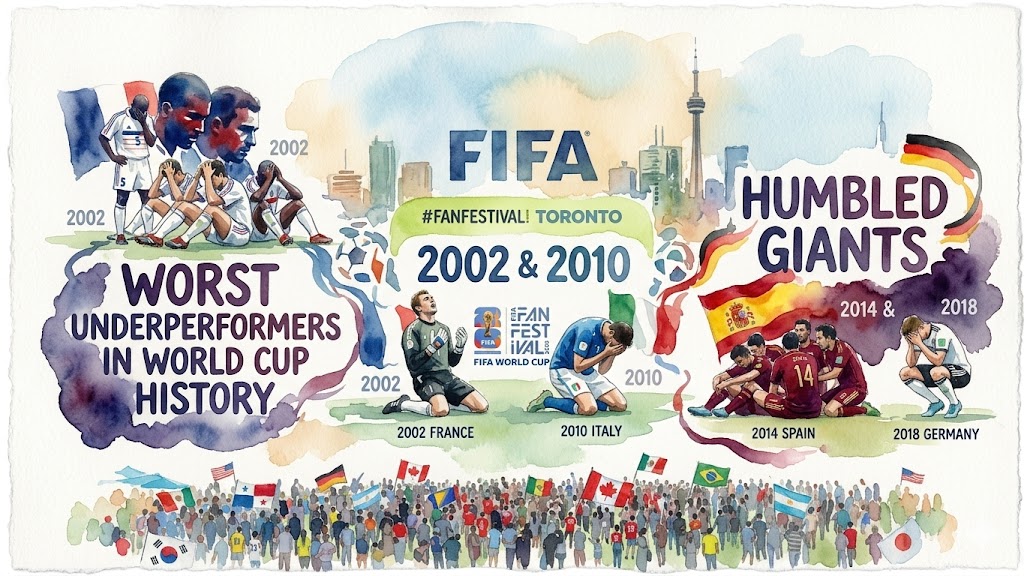
The Worst Underperformers in World Cup History
Massive pre-tournament expectations can quickly morph into heavy psychological burdens. Throughout football history, several teams boasting elite international superstars have collapsed entirely on the grandest stage. Reviewing the worst underperformers in World Cup history provides a fascinating look at tournament football’s uncertain nature. Ultimately, these historic campaigns crashed out early due to sudden tactical errors and deep structural collapses.
📊 Underperformers in World Cup: Iconic Tournament Flops
Sustaining elite form under intense global scrutiny requires immense collective focus. The table below represents the underperformers in World Cup of all-time, that suffered the most dramatic drops in performance relative to their high pre-tournament expectations.
| Tournament | National Team | Pre-Tournament Status | Actual Tournament Result | Era-Defining Icons | Primary Catalyst for Failure |
| 1994 | Colombia | Anointed Title Favorites | Group Stage Elimination | Carlos Valderrama, Faustino Asprilla | Heavy pressure, tactical rigidity |
| 2002 | France | Defending World & Euro Champions | Group Stage Elimination (Last) | Thierry Henry, Patrick Vieira | Zidane injury, attacking arrogance |
| 2014 | Spain | Defending World & Euro Champions | Group Stage Elimination | Xavi, Andrés Iniesta, Iker Casillas | Aging core, tactical predictability |
| 2018 | Germany | Defending World Champions | Group Stage Elimination (Last) | Toni Kroos, Thomas Müller, Mats Hummels | Complacency, defensive vulnerability |
| 2026 | Turkey | Highly Fancied Dark Horse | Group Stage Elimination | Arda Güler, Kenan Yıldız | Ineffective attack, early tactical panic |
🇨🇴 Colombia (1994): The Ultimate Psychological Trap
No team has ever carried a heavier burden of expectation into a tournament than the 1994 Colombian squad. After dismantling Argentina 5-0 in a legendary qualifying match in Buenos Aires, Pelé publicly anointed Colombia as his absolute favorite to win the entire tournament in the United States.
| Campaign Phase | Event & Details | Primary Structural Impact |
| Pre-Tournament Hype | • Historic 5–0 victory over Argentina in Buenos Aires during qualification. • Publicly backed by legend Pelé to win the entire tournament. | Created immense, suffocating pressure from global media and intense national expectations. |
| Match 1 Flop | Stunned 3–1 by a highly clinical Romania side led by Gheorghe Hagi. | Exposed severe defensive vulnerabilities and shattered the squad’s on-field confidence. |
| Match 2 Reject | Devastating 2–1 loss to the host United States, marred by Andrés Escobar’s tragic own goal. | Sealed an early exit from the competition and intensified toxic off-field distractions. |
Leaning on the brilliant playmaking of Carlos Valderrama and the explosive attacking pace of Faustino Asprilla, Colombia was expected to cruise through the opening rounds. Instead, they fell into an immediate psychological trap. They were soundly beaten 3-1 by a highly organized Romania in their opener, before a devastating 2-1 defeat against the host United States—marred by Andrés Escobar’s tragic own goal—eliminated them before the final group matchday even kicked off.
🇫🇷 France (2002): The Scoreless Champions
The French collapse at the 2002 tournament in South Korea and Japan remains one of the most shocking chapters in modern football. Les Bleus arrived in East Asia holding both the 1998 World Cup and Euro 2000 trophies, boasting an elite squad that featured the top goalscorers from the English Premier League (Thierry Henry), French Ligue 1 (Djibril Cissé), and Italian Serie A (David Trezeguet).
When talismanic midfielder Zinedine Zidane suffered a severe thigh injury right before the tournament opener against debutants Senegal, a wave of tactical passed through the the squad. France looked completely sluggish in a shock 1-0 opening defeat to the African nation, fought to a turgid 0-0 draw with Uruguay, and unceremoniously crashed out following a 2-0 loss to Denmark. They finished dead last in their group, becoming the first defending champions in history to exit the tournament without scoring a single goal.
🇪🇸 Spain (2014) & 🇩🇪 Germany (2018): The Champions’ Curse
The modern era witnessed two European soccer powerhouses succumb to the notorious “Defending Champions’ Curse,” where tactical complacency completely eroded world-class rosters.
Spain’s Tiki-Taka Meltdown
Spain arrived in Brazil in 2014 aiming to defend their historic treble of international trophies. However, Vicente del Bosque’s aging core was completely exposed in their opening match in Salvador. Replicating the ultimate underperformance layout, a relentless Netherlands side exacted sweet revenge for the 2010 final, smashing Spain 5-1 via spectacular counter-attacking transitions. A subsequent 2-0 defeat to Chile officially brought a brutal, abrupt end to the golden era of Tiki-Taka.
Germany’s Kazan Catastrophe
Four years later, Germany replicated Spain’s exact pattern of failure in Russia. After hoisting the trophy in Rio de Janeiro, Joachim Löw’s squad looked completely devoid of defensive cohesion or urgency. Following an opening defeat to Mexico, they required a 95th-minute Toni Kroos free-kick against Sweden to stay alive. Needing a simple victory over South Korea in Kazan to advance, Germany conceded twice in stoppage time to lose 2-0, crashing out in the group stage for the first time since 1938.
📱 Live Tournament Statistics and Supporter Subsystems
As teams battle across the North American continent, the boundary between elite performance and a historical collapse remains razor-thin. Tactical adjustments, conditioning under intense summer humidity, and squad harmony dictate exactly who thrives and who joins the ranks of the tournament’s greatest disappointments.
To look over detailed tournament match archives and review complete squad performance metrics, check out the central data vaults. If you want a handy digital companion on your phone to track active match brackets, view live scoreboards, and the poorest the worst underperformers in world cup history with fellow supporters, the Longfu88 Fan Community serves as an exceptional mobile resource. To track group tables and follow comprehensive technical match statistics natively on your browser all summer long, make sure to visit Longfu88.com.
Official Tournament Flops FAQ
Which nation has been eliminated in the group stage the most times as defending champions?
Four different defending champions have suffered immediate group-stage exits in the modern era: France (2002), Italy (2010), Spain (2014), and Germany (2018). Brazil remains the only modern champion to successfully navigate the group stage following a title win, reaching the quarter-finals in 2006.
What is considered the single biggest match upset by scoreline in history?
While Germany’s iconic 7-1 dismantling of hosts Brazil in the 2014 semi-final the single most the most humiliating defeat ever suffered by a major footballing superpower, the biggest statistical upset in terms of pre-match expectations belongs to the United States’ 1-0 victory over a heavily favored England squad in Belo Horizonte in 1950.
Did any host nation ever finish last in their group during a tournament?
Yes. South Africa became the first host nation in history to fail to progress past the group stage in 2010, though they avoided finishing last by claimimg a historic 2-1 victory over a collapsing French squad in their final match. In 2022, hosts Qatar became the worst-performing host nation ever, losing all three of their group stage matches and finishing dead last in the overall tournament rankings.