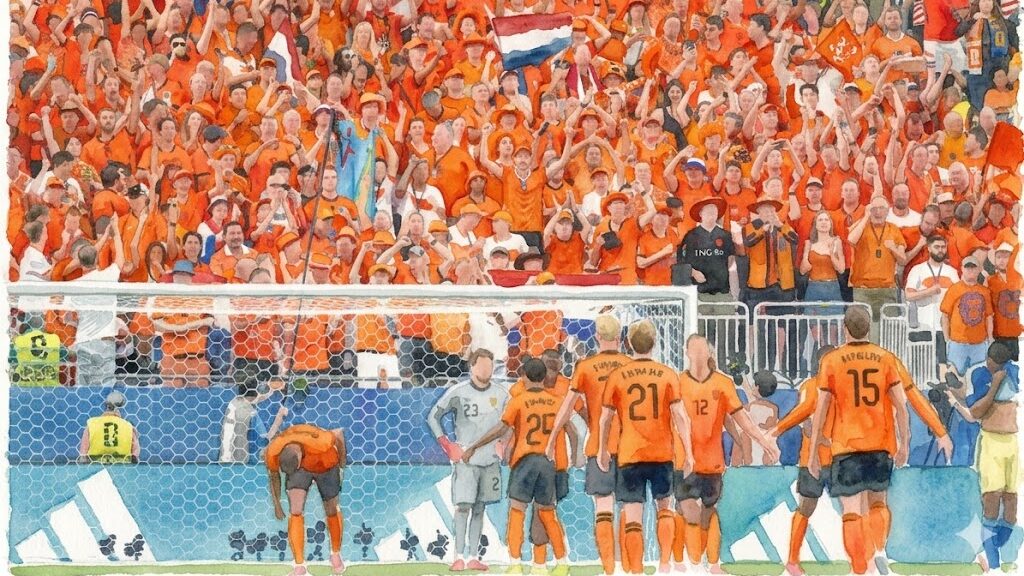
Sustained Dominance: The Longest Unbeaten Runs in World Cup History
When studying the longest unbeaten runs in World Cup history, fans witness the absolute pinnacle of collective resilience. While widely considered the best footballing nation to never lift the trophy, the Netherlands remains a historic anomaly. They endure the heartbreak of three final defeats, yet they boast an incredibly resilient tournament footprint.
Today, the 2026 squad is making a massive statement on North American soil. Following a tense 2–2 draw against Japan, they completely dismantled Sweden 5–1 to claim control of Group F. By doing so, they extended their active, record-breaking unbeaten streak in open play to 14 matches—the longest run in World Cup history.
By suffering only two losses in 25 World Cup matches this century, the Dutch have firmly established themselves as a powerhouse. Consequently, no opponent wants to face this resilient squad in the upcoming knockout rounds.
📊 The Longest Unbeaten Runs in World Cup
Maintaining a flawless ledger through consecutive tournament cycles is an extraordinarily rare feat. The table below outlines the elite tier of national teams that have engineered the most enduring undefeated stretches ever witnessed.
| National Team | Matches Unbeaten | Timeframe / Era | Era-Defining Icons | Ultimate Streak Conclusion |
| Netherlands | 14 Matches | 2014 – 2026 (Active) | Arjen Robben, Cody Gakpo, Brian Brobbey | Streak Active |
| Brazil | 13 Matches | 1958 – 1966 | Pelé, Garrincha, Zagallo | Hungary 3-1 Brazil (1966) |
| Germany (West) | 11 Matches | 1978 – 1982 | Karl-Heinz Rummenigge, Paul Breitner | Algeria 2-1 West Germany (1982) |
| Italy | 10 Matches | 1934 – 1950 | Giuseppe Meazza, Vittorio Pozzo (Coach) | Sweden 3-2 Italy (1950) |
🇳🇱 The Modern Record-Breaker: The Dutch Masterclass
A historic shift occurred during the group stages of the summer tournament in North America. Following a spectacular 5-1 thrashing of Sweden at Houston Stadium, the Netherlands officially claimed the longest unbeaten runs in world cup history, moving to 14 consecutive games without a loss.
The Statistical Fine Print
The survival of the Dutch streak highlights a fascinating element of sports data capturing. The Netherlands have not tasted an outright defeat in regulation or extra time since the 116th minute of the 2010 Final in Johannesburg. Argentina eliminated the Dutch from the 2014 and 2022 tournaments via penalty shootouts. However, official statistical bodies code penalty shootout outcomes as draws rather than losses.
By remaining undefeated inside 90 and 120 minutes across three consecutive tournament appearances, Ronald Koeman’s squad bypassed a 60-year-old milestone. Furthermore, their relentless group-stage form is arguably even more staggering: the Oranje haven’t lost a single group-stage match in 32 years, a run spanning 18 matches since 1994.
🇧🇷 The Pelé Era: Brazil’s Samba Reign (1958–1966)
Before the modern Dutch side reshaped the record books, the benchmark for footballing excellence belonged entirely to the iconic Brazilian squads of the mid-20th century. Spanning 13 matches, Brazil went completely untouched through back-to-back championship runs in Sweden (1958) and Chile (1962).
Led by a teenage Pelé and the magical dribbling wizardry of Garrincha, the Seleção dismantled tactical systems with revolutionary attacking fluidness. This legendary stretch finally met its demise at the 1966 tournament in England, where a Pelé-less Brazil fell 3-1 to an aggressive, highly organized Hungary side during a fiery group-stage encounter.Unlike the modern record holders, however, Brazil translated their 13-game unbeaten run into two sparkling Jules Rimet trophies, cementing their position as perhaps the most dominant collective ever assembled.
🇩🇪 European Powerhouses: Germany and Italy’s Iron Defensive Fortresses
Adjacent to the top spots, West Germany and Italy utilized distinct defensive styles to carve out their own chapters of sustained tournament excellence.
Italy’s 10-match streak across the 1934 and 1938 iterations represents the golden age of the tactical system known as Metodo, pioneered by legendary coach Vittorio Pozzo. The Azzurri became the first nation to defend a global title successfully, utilizing physical conditioning and disciplined counter-attacking structures. The streak was frozen for twelve years due to the global suspension of sports during World War II, finally concluding with a 3-2 loss to Sweden in 1950. West Germany engineered an 11-match undefeated block between 1978 and 1982, leaning on the clinical finishing of Karl-Heinz Rummenigge before suffering one of the greatest upsets in sports history—a 2-1 defeat to debutants Algeria.
📱 Live Tournament Analytics and Community Sync
As international teams continue to battle across the North American tournament grid, they challenge historical benchmarks in real time. Tactical adaptations, defensive setups, and unexpected giant-killings shape the narrative of the sport with every passing match week.
To check out detailed historical game files, look straight to the central tournament data vaults. If you want an interactive mobile companion on your phone to track active match brackets, review live scoreboards, and chat about the longest unbeaten runs in world cup history with fellow supporters, the Longfu88 Fan Community offers an exceptional resource. To analyze group tables and follow comprehensive technical match metrics natively on your screen all summer long, make sure to visit Longfu88.com.
Official Tournament Record FAQ
Why are matches decided by a penalty shootout recorded as draws in historical statistics?
Under standardized rules, international football governing bodies and data agencies strictly consider a penalty shootout a tie-breaking mechanism to determine which team advances. Because the scoreline remains completely level at the conclusion of 120 minutes of active play, historical archives officially log the match as a draw for both teams.
Which player has made the most appearances during an individual unbeaten run?
Legendary German goalkeeper Manuel Neuer holds the all-time appearance record for a shot-stopper, clearing his 21st tournament appearance during the group stages. For outfield players during an unbeaten era, icons like Pelé and Franz Beckenbauer logged substantial minute counts, though modern tournament expansions mean modern players frequently accumulate higher total match volumes.
Has any nation ever gone entirely undefeated across a tournament claiming the trophy?
Yes, this is a relatively common occurrence due to group stage draws and penalty shootout eliminations. Famous examples include New Zealand at the 2010 tournament, where three group stage draws left them undefeated but eliminated, and the Netherlands in 2014, who claimed a third-place finish without losing a single game in normal or extra time.